
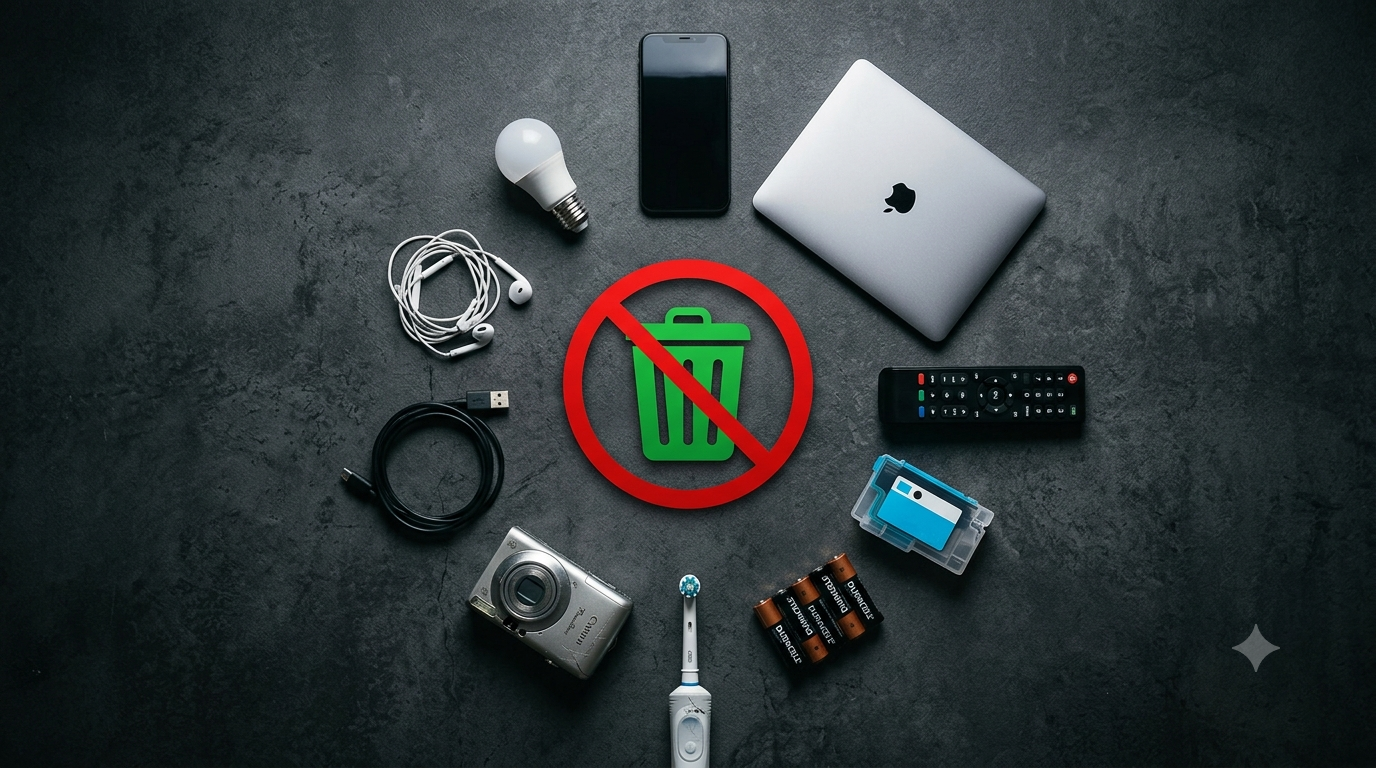
Every day, millions of Indians throw old electronics into the regular dustbin without giving it a second thought. A dead phone battery here. A broken charger there. An old TV remote. It seems harmless — but it is not.
Under India's E-Waste Management Rules, 2022, improperly discarding electronics is not just irresponsible — it is illegal. More importantly, the toxic materials inside these devices cause real, lasting damage to our soil, water, and health.
Here are the top 10 electronics you must never throw in the regular bin — and exactly what you should do with them instead.
Quick Rule of Thumb
- If it has a plug, a battery, or a screen — it is e-waste and must NOT go in regular trash.
- Under India's E-Waste Rules 2022, producers and consumers both have disposal responsibilities.
- Always hand over old electronics to a CPCB-authorized recycler or an authorized collection point.
- You can request a free pickup from Universal Power Solutions for bulk e-waste across India.
01. Smartphones & Mobile Phones
Your old smartphone is one of the most complex pieces of e-waste you own. It contains gold, silver, copper, and palladium in its circuit board — and lithium, cobalt, and nickel in its battery. When thrown in a landfill, the battery can swell, rupture, and leak electrolytes into the ground. In some cases, crushed lithium batteries have started fires in waste trucks and landfills.
What to do: Use your phone brand's take-back programme, drop it at an authorized e-waste collection point, or schedule a pickup with a CPCB-authorized recycler. Before handing it over, always perform a factory reset to wipe personal data.
02. Laptops & Tablets
Laptops and tablets contain lithium-ion battery packs, mercury-containing backlights (in older models), and dense printed circuit boards loaded with precious and hazardous metals. A single laptop battery contains enough lithium to cause a serious fire if punctured under pressure in a compactor truck.
What to do: Back up your data, perform a full wipe, remove any SIM cards or memory cards, and hand the device over to an authorized recycler. Many laptop brands offer free take-back or trade-in programmes.
Recycling one million laptops saves energy equivalent to powering 3,500 homes for a full year. The materials recovered — aluminium, copper, gold — go directly back into manufacturing new devices.
03. Batteries of All Types
This includes AA, AAA, C, D cells, coin batteries, lithium-ion packs, lead-acid batteries, and NiCd batteries. Every single type of battery contains hazardous materials — lead, cadmium, mercury, lithium, or strong acid — that must not enter regular waste streams. India discards hundreds of millions of batteries every year, the vast majority into regular trash.
What to do: Store used batteries in a dry, sealed container. Drop them at electronics retailers, battery brand collection points, or contact an authorized recycler for bulk pickup. Never puncture, burn, or crush batteries.
04. CRT & LCD Televisions and Monitors
Old CRT (Cathode Ray Tube) televisions are among the most hazardous items in any home. A single CRT TV contains 2–4 kg of lead in the glass funnel alone. LCD screens contain indium — a rare, valuable metal — and older LCD backlights contain mercury-filled fluorescent tubes that shatter easily and release toxic vapour.
What to do: Never put a CRT TV in a regular skip or dumping yard. Contact a CPCB-authorized recycler who has the equipment to handle CRT glass safely. This is not a job for the local kabadiwala.
05. Refrigerators & Air Conditioners
Large home appliances — refrigerators, ACs, washing machines, and microwaves — fall under e-waste regulations in India. Refrigerators and ACs contain refrigerant gases (CFCs and HFCs) that are potent greenhouse gases and ozone-depleting substances. Releasing them into the atmosphere during dismantling is both illegal and catastrophically harmful to the environment.
What to do: Only hand old ACs and refrigerators to service technicians or recyclers who have certified gas recovery equipment. Under no circumstances should the refrigerant gas be vented directly into the air.
The refrigerant in one domestic air conditioner, if released uncontrolled, has a global warming potential equivalent to several tonnes of CO₂. Certified recovery and recycling prevents this entirely.
06. Printers, Scanners & Ink Cartridges
Printers contain circuit boards, motors, and plastic housing that all qualify as e-waste. But the most overlooked item is the ink cartridge. Empty ink cartridges still contain residual ink — a chemical mixture that stains soil and contaminates groundwater. Toner cartridges from laser printers contain ultra-fine carbon particles that are hazardous if inhaled and extremely persistent in the environment.
What to do: Many printer brands (HP, Canon, Epson) have cartridge take-back programmes at their service centres. Full printers should be handed to authorized e-waste recyclers. Never break open cartridges or empty them into sinks.
07. Fluorescent Lamps & LED Bulbs
Compact fluorescent lamps (CFLs) contain mercury vapour — if one breaks in your home, it releases enough mercury to require ventilation and careful cleanup. When thrown in regular trash and crushed in waste trucks, they release mercury into the immediate environment. Even LED bulbs contain small amounts of lead, arsenic, and nickel in their components.
What to do: Many municipalities have lamp drop-off points. Electrical retailers and lamp brands often accept returns. For bulk quantities — offices, factories, housing societies — contact an authorized recycler for collection.
08. Power Banks & Chargers
Power banks are essentially lithium-ion battery packs in a plastic shell — with all the associated fire and chemical hazards. They are one of the most commonly discarded items in regular trash, yet one of the most dangerous. Chargers and adapters contain circuit boards with lead solder, brominated flame retardants, and copper that leach when landfilled.
What to do: Drop swollen or damaged power banks at an authorized collection point immediately — do not keep them in enclosed spaces. Never throw them in regular trash or post them without hazardous goods packaging. Hand functional but unwanted power banks to recyclers.
09. Cables, Wires & Networking Equipment
USB cables, HDMI cables, ethernet cables, old telephone wires, routers, modems, and switches — all of these are e-waste. Cables contain copper, PVC plastic, and in older cables, lead-stabilized insulation. Burning cables to extract copper — a common practice in informal recycling — releases highly toxic dioxins and furans into the air.
What to do: Bundle old cables and networking equipment and hand them over to an authorized recycler. The copper inside is valuable — a legitimate recycler will recover it safely without burning. Never burn or bury cables.
10. Medical & Monitoring Devices
Thermometers (especially old mercury-in-glass types), blood pressure monitors, glucometers, pulse oximeters, and other home health devices are increasingly common — and increasingly discarded. Old mercury thermometers are particularly dangerous: a single broken thermometer can contaminate a room with enough mercury vapour to require professional decontamination.
What to do: Mercury thermometers should be sealed in an airtight container and handed to an authorized hazardous waste facility. Electronic medical devices should be treated as standard e-waste and given to certified recyclers. Never throw them in the bin, and never break them.
The Simple Rule: When in Doubt, Don't Bin It
If a device has a plug, a battery, a screen, or a circuit board — it is e-waste. And in India, e-waste has a dedicated, regulated disposal system for good reason. The materials inside these devices are too valuable to waste and too hazardous to ignore.
The next time you clear out your drawer of old gadgets, resist the temptation to throw them in the regular dustbin. A single phone call or a scheduled pickup with Universal Power Solutions is all it takes to dispose of them safely, legally, and responsibly.
Have Old Electronics Piling Up?
Universal Power Solutions offers CPCB-authorized doorstep e-waste pickup for homes, offices, and businesses across India. All items accepted. Full documentation provided.
Book a Free Pickup